Can patents be renewed? The short, honest answer is no — patents cannot be renewed the way you renew a passport or a subscription. Once a patent’s legal term expires, that invention permanently enters the public domain, free for anyone in the world to use. But here’s the part most inventors miss: there are legal mechanisms that can extend a patent’s life under specific conditions — and missing them could cost you years of hard-won exclusivity.
If you’re wondering whether your patent can be renewed, extended, or kept alive longer, this guide covers everything you need to know — with verified facts, real deadlines, and actionable steps.
Can Patents Be Renewed After They Expire?
Can patents be renewed after expiry? No — and this is one of the most misunderstood facts in intellectual property law. Once a patent’s term ends, the invention moves into the public domain permanently. There is no renewal window, no extension filing, and no way to restore exclusivity.
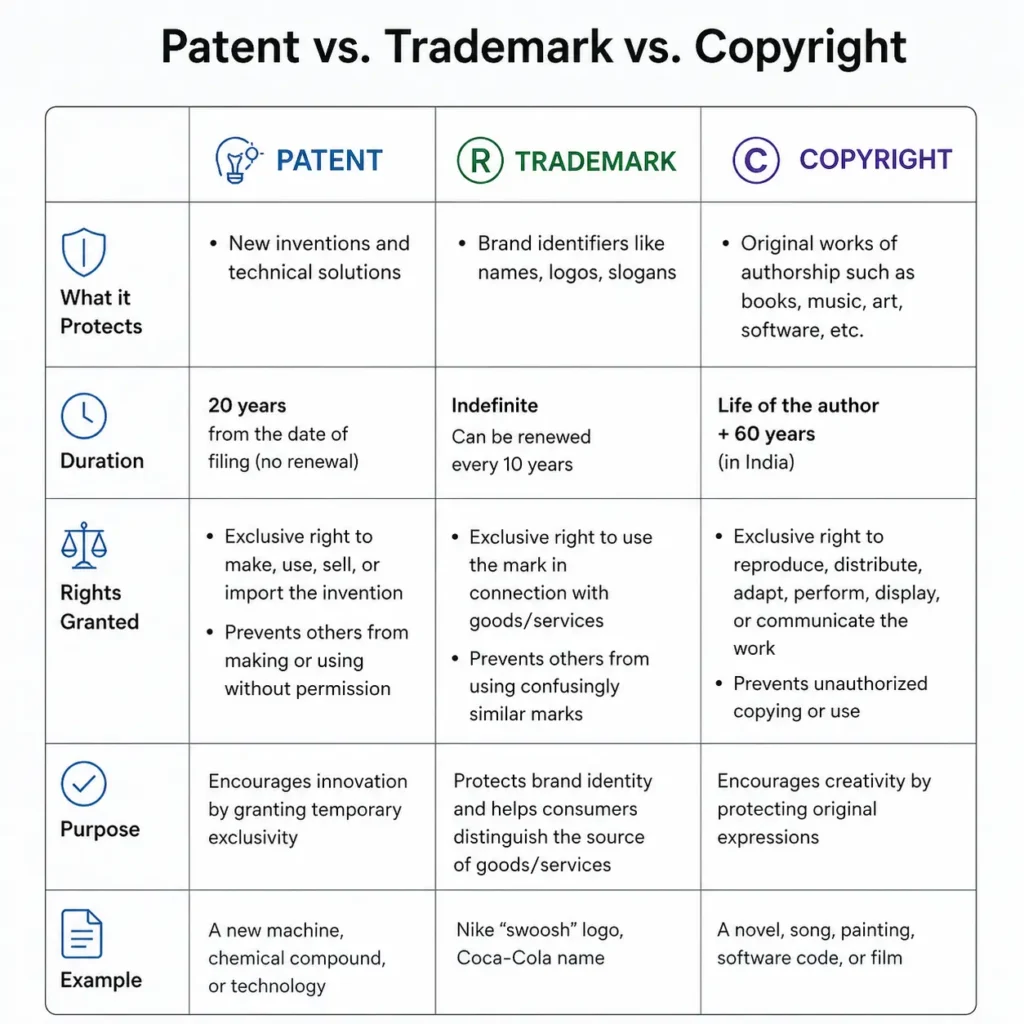
This is fundamentally different from trademarks, which can be renewed indefinitely as long as the owner continues using them in commerce. Patents are deliberately time-limited — that’s the social contract behind them. Society grants inventors a temporary monopoly; in return, the invention eventually becomes freely available to everyone.
So why do so many people search “can patents be renewed”? Because they’re often confusing two very different things: renewal (which doesn’t exist) and maintenance fees (which absolutely do, and which keep your patent alive during its term). More on that shortly.
How Long Does a Patent Last Before You Need to Worry?
Can patents be renewed only matters if you first understand how long they last. The standard patent term is 20 years from the application filing date — a global standard established under the WTO’s TRIPS Agreement.
Here’s a breakdown by patent type:
- Utility patents — the most common type — last 20 years from the filing date under 35 U.S.C. § 154
- Design patents in the US last 15 years from the grant date — no maintenance fees required
- Plant patents last 20 years and also require no maintenance fees
- Provisional applications are not enforceable patents at all — they expire after just 12 months and must be converted to a non-provisional filing within that window
One critical nuance: the 20-year clock starts from the filing date, not the grant date. Since USPTO examination typically takes 2–3 years, most inventors effectively have only 17–18 years of actual commercial protection. That makes every day — and every deadline — count.
What Are Patent Maintenance Fees — and Can They Act as a Renewal?
Patent maintenance fees are the closest thing to “renewing” a patent — and missing them is how thousands of patents die prematurely every year. These are mandatory periodic payments that keep a granted utility patent legally active during its 20-year term.
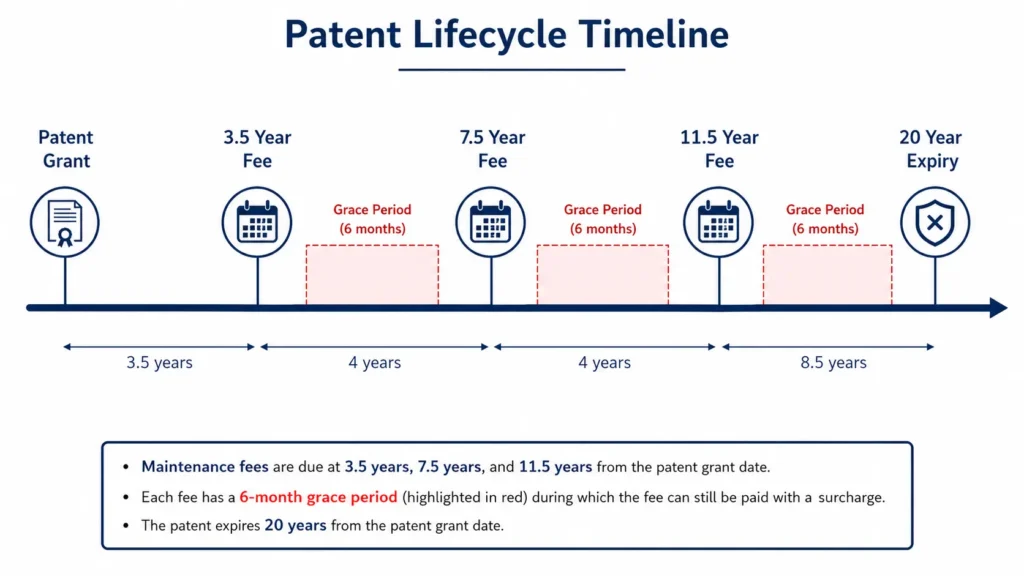
In the United States, the USPTO requires maintenance fees at three key intervals after the grant date:
- 3.5 years after grant
- 7.5 years after grant
- 11.5 years after grant
There is a six-month grace period after each due date, but a surcharge kicks in immediately once the deadline passes. If the fee plus surcharge is not paid within that six-month window, the patent lapses — and enters the public domain.
The fee amounts scale by entity size:
- Large entity — ~$1,600 at year 3.5 | ~$3,600 at year 7.5 | ~$7,400 at year 11.5
- Small entity (individuals, businesses under 500 employees, universities) — pays 50% of large entity fees
- Micro entity — pays just 25% of large entity fees, a major relief for independent inventors
Here’s a sobering statistic: according to UpCounsel, approximately 50% of all US utility patents lapse early simply because their owners stop paying maintenance fees — not because the invention lost value, but because the deadline was overlooked or the decision was made passively. Don’t let that be your patent.
Can Patents Be Renewed Through a Term Extension? Understanding PTA and PTE
Can patents be renewed through legal extensions? In limited circumstances, yes — a patent’s life can be extended, though not renewed. Two specific mechanisms exist: Patent Term Adjustment (PTA) and Patent Term Extension (PTE). They sound alike but solve different problems.
Can Patents Be Renewed via Patent Term Adjustment (PTA)?
Patent Term Adjustment compensates inventors when the USPTO itself causes delays during examination.
Under 35 U.S.C. § 154(b), if the USPTO misses its own response deadlines during prosecution, the applicant earns extra days — day for day — added to the end of the patent term. This applies to all applications filed on or after May 29, 2000, and the adjustment is printed directly on the front page of the granted patent.
The catch: any delays caused by the applicant (such as a late response to an Office Action) are subtracted from the total adjustment. So slow responses by your legal team can cost you real days of patent life.
Can Patents Be Renewed via Patent Term Extension (PTE)?
Patent Term Extension is a more powerful mechanism — and far more rare. It was specifically designed for industries where regulatory approval delays erode commercial patent life.
Under the Hatch-Waxman Act of 1984 (35 U.S.C. § 156), patent holders in pharmaceuticals, medical devices, veterinary products, food additives, and color additives can apply for a PTE when FDA review consumes years of their patent’s effective commercial window. If you invented a cancer drug in 2005 but only received FDA approval in 2017, twelve years of your patent were effectively wasted — PTE exists to partially compensate for that.
Key facts about Patent Term Extension:
- The applicant must demonstrate due diligence throughout the regulatory review period
- Maximum extension: 5 years
- Total patent life (original term + PTE) cannot exceed 14 years from the FDA product approval date
- Application must be filed within 60 days of receiving marketing approval — this deadline is strict and non-negotiable
- Only one patent per approved product qualifies for PTE
The Hatch-Waxman framework has generated over $100 billion in additional pharmaceutical revenues since its introduction, while simultaneously enabling the generic drug industry through abbreviated approval pathways. It’s one of the most consequential pieces of IP legislation in US history.
Can Patents Be Renewed or Extended Internationally?
Can patents be renewed under other countries’ laws? Each jurisdiction has its own rules — and the differences matter enormously for global IP strategy.
Here’s how the major jurisdictions compare:
United States: PTE under the Hatch-Waxman Act — up to 5 years, capped at 14 years post-approval. Applies to pharma, medical devices, veterinary, food/color additives.
European Union: Uses Supplementary Protection Certificates (SPCs) under Regulation 469/2009 — up to 5 additional years, with total protection not exceeding 15 years from first EU marketing authorization. An extra 6-month extension is available for paediatric medicines.
Japan: Allows up to 5 years of term extension for pharmaceuticals and agrochemicals. Uniquely, Japan has a minimum extension of 2 years — even if the regulatory delay was shorter. Applications must be filed within 3 months of first regulatory approval.
Australia: PTE of up to 5 years for pharmaceutical patents, provided at least 5 years elapsed between the filing date and first marketing approval. Applications must be filed within 6 months of either patent grant or first regulatory approval — whichever is later.
India: Currently does not permit patent term extension — even for pharmaceuticals. The Indian Patents Act, 1970 (amended in 2005 under TRIPS compliance) strictly caps all patent life at 20 years. This is a deliberate public health policy. India’s Section 3(d) also blocks “evergreening” — minor modifications designed to extend monopoly rights without genuine innovation. This policy is a key reason India supplies nearly 20% of the world’s generic medicines by volume.
What Happens to an Invention When a Patent Expires?
Can patents be renewed once they enter the public domain? Absolutely not — and the consequences are immediate. The moment a patent expires (whether after 20 years or early from missed fees), the invention becomes public property.
Anyone — a competitor, a manufacturer, a startup — can legally:
- Manufacture and sell the invention
- Import it from any country
- Build on it or incorporate it into new products
- License it to others without paying the original inventor
There is no cooling-off period, no notice requirement, no grace window after expiry. The day the patent dies, the monopoly ends.
This is exactly why generic drug companies monitor pharmaceutical patent expiry calendars years in advance. The moment a blockbuster drug patent expires, multiple generic versions hit the market — often driving prices down by 80–90% within months.
One important clarification many inventors get wrong: expiry does not erase prior art. A patent that lapses or expires still counts as prior art against future applications. Competitors cannot re-patent the same invention just because the original patent is gone.
Smart Strategies to Protect Your Invention Beyond the Patent Term
Can patents be renewed? No. But can you protect your invention’s commercial value beyond 20 years? Absolutely — with the right strategy.
Here are five proven approaches:
1. File continuation or improvement patents. If your invention has evolved — new features, new uses, new manufacturing methods — those improvements may qualify for fresh patent protection. This is legal and widely practiced. It’s distinct from evergreening because it protects genuinely new innovations.
2. Layer trademark protection. Brand names, product shapes, and distinctive product identifiers can be trademarked indefinitely with continued use. Many products that lost patent protection still dominate markets through brand recognition alone.
3. Develop trade secrets. Formulas, processes, or methods that aren’t reverse-engineerable can be protected as trade secrets — with no expiration date and no public disclosure requirement. Coca-Cola’s formula has been a trade secret for over 130 years.
4. Pursue PTE proactively. If you’re in an eligible industry, don’t wait for approval to think about PTE. Start tracking regulatory review timelines from the IND stage so you’re ready to file within the 60-day window.
5. Work with a specialized IP firm. Patent strategy is technical, deadline-driven, and jurisdiction-specific. A misstep can cost you years of protection. Firms like Akhildev IPR and Research Services provide end-to-end intellectual property lifecycle management — from patent filing and prosecution to maintenance tracking, global portfolio strategy, and term extension advisory. Their expertise ensures that no deadline slips through the cracks, and that every available day of protection is maximized.
Quick Reference: Can Patents Be Renewed — Key Facts
| Factor | Details |
|---|---|
| Can patents be renewed? | No — patents cannot be renewed once expired |
| Standard utility patent term | 20 years from filing date |
| Design patent term (US) | 15 years from grant date |
| Maintenance fees due | 3.5, 7.5, and 11.5 years after grant |
| Grace period for late fees | 6 months (with surcharge) |
| Patents lapsing from missed fees | ~50% of all utility patents |
| Max Patent Term Extension (US) | 5 years (pharma/medical only) |
| Total life cap with PTE (US) | 14 years post-FDA approval |
| EU equivalent | Supplementary Protection Certificate (SPC) — up to 5 years |
| India’s policy | No patent term extension allowed |
| PTE filing deadline | 60 days from FDA marketing approval |
Final Word:
Can patents be renewed? In the strict legal sense, no. But the picture is more nuanced than a flat no suggests. With timely maintenance fee payments, strategic PTE filings, continuation patents, and complementary IP layers, inventors can significantly extend their competitive advantage — often well beyond the base 20-year window.
The critical mistake is passivity. Patent law doesn’t send you friendly reminders or second chances. Deadlines expire, grace periods close, and once a patent enters the public domain, there is no path back.
Whether you’re filing your first patent, managing a global IP portfolio, or staring down an impending expiry date, Akhildev IPR and Research Services has the expertise to help you act decisively and protect what you’ve built.